The Littlewood Treaty, The True English Text of the Treaty of Waitangi, Found
Chapter: Précis 1 2 3 4 5a, 5b, 5c, 5d, 5e 6 7 8 9 10 11 12 13 14 15 16 17 18 19 20 Lord Normanby's Brief Additional Resources
Chapter 12
COMMODORE WILKES VISITS THE BAY OF ISLANDS
About two weeks after receiving the official documentation, Clendon was
able to make copies of these items, ‘placed in my hands’, available
to United States Antarctic Explorer, Commodore Charles Wilkes, who sailed
into the Bay of Islands aboard his flagship, Vincennes, on March 29th 1840.
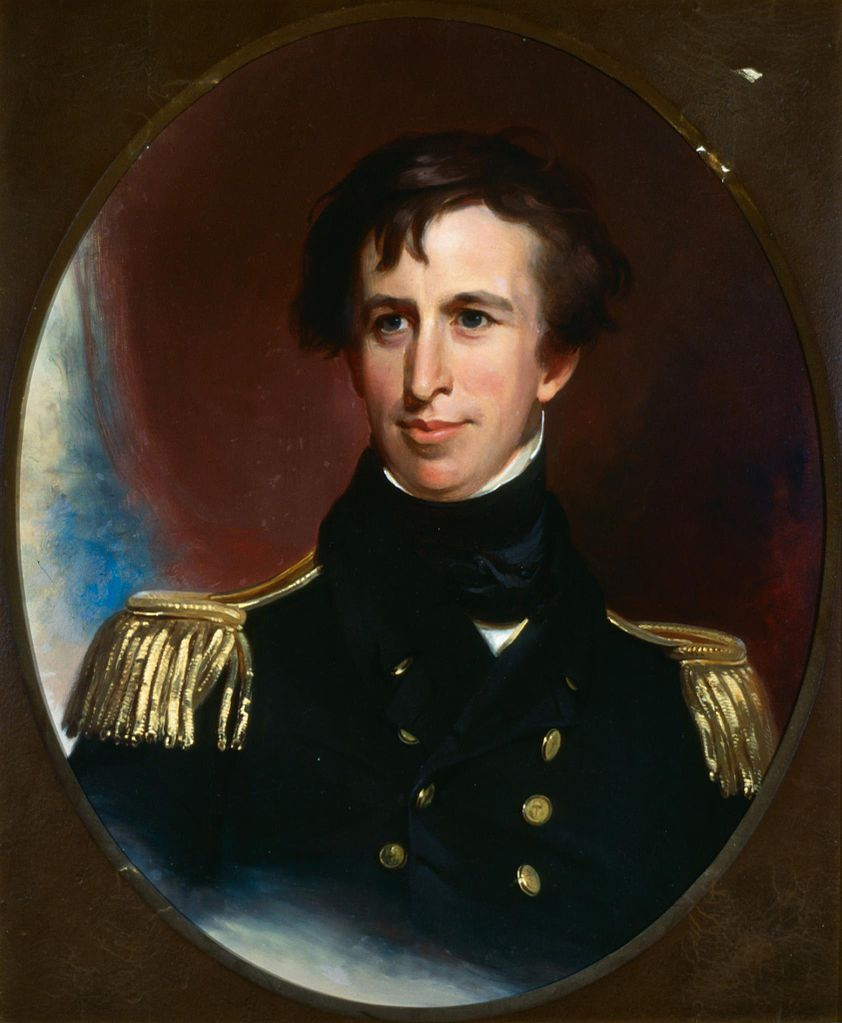
Commodore Charles Wilkes, leader of the American Antarctic Expeditionary squadron of six ships. Wilkes visited the Bay of Islands on March 29th 1840 and remained until mid-April. Upon arrival he requested that U.S. Consul James Reddy Clendon supply him with official treaty-related materials in both English and Maori for despatch to the United States Government.
Wilkes arrived from N.S.W. Australia, to rejoin two of the somewhat battered vessels (Porpoise and Flying Fish) of his Antarctic expeditionary squadron, lying at anchor and undergoing repairs in Kororareka Bay. Commodore Wilkes had heard from sources in N.S.W. that a British colony in progress was underway in New Zealand and about the Proclamations read by Hobson on the 30th of January 1840. A U.S. Lieutenant, seemingly from Wilkes’ squadron, who had come over as an observer from Australia on the British store ship, Samuel Winter, was staying with Clendon on the 3rd of February and also attended the Treaty of Waitangi assembly on the 5th of February 1840. Perhaps the Lieutenant managed to acquire copies of the Proclamations read 5-days before and returned them to his commander. Commodore Wilkes was particularly concerned about the effect British annexation would have upon the lucrative American whaling industry in the region and wished to send a despatch to the U.S. Secretary of State describing local political happenings. In order to create an informed despatch he would have to rely heavily on Clendon for intelligence and official documentation.
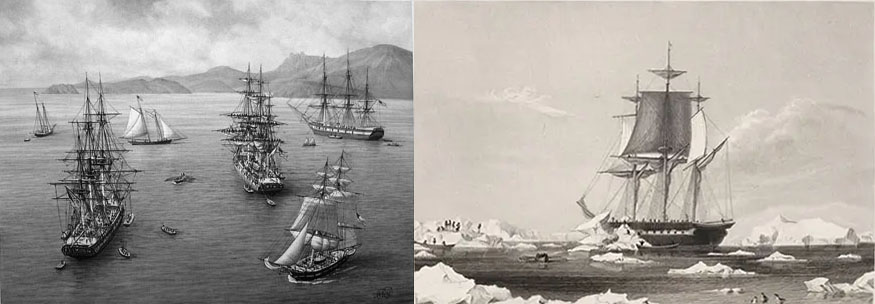
The Antarctic Expeditionary squadron of six ships, including Wilkes’ flagship, Vincennes, together at a South American port just prior to their dangerous exploration of the Southern Continent. Later, after damaging their vessels in collisions with pack ice, the ships, Porpoise and Flying Fish limped to the preassigned rendezvous port of the Bay of Islands, New Zealand, in March 1840. The U.S.S. Vincennes later joined them on the 29th of March 1840, when Wilkes sailed from Australia to find the lost ships of his scattered and battered squadron.
Wilkes wrote to the U.S Secretary of State:
‘I have the honor to inform you of my arrival at this
place on the 29th March after 10 days passage from Sydney N.S. Wales.
Previous to my arrival here I had been informed of the different proclamations
made by the Gov. of N.S. Wales in the name of the Queen, extending the authority
of the British realm over these islands and the appointment of a Lt. Governor
in case the chiefs were willing to sign over their rights to her Majesty.
On my arrival here I lost no time to inquire into the actual state of these
islands and what acts had taken place and how for the authority of the British
Govt. had gone, and for the information of the Govt., I now give the result
of it.
On addressing the U.S. Consul J.R. Clendon Esq. on the subject I received
from him a letter, a copy of which is hereto annexed marked A.
I likewise have obtained a copy of the Treaty (a translation) also annexed
and marked B & C in which the Govt. have all the information that has
yet been made public’ (See Papers of Charles Wilkes 1837-1847,
U.S.S. Vincennes letter book copy of despatch Number 64, Microfilm 1262,
University of Auckland Library pp. 163-164, originals at the Kansas Historical
Society, Topeka, Kansas, U.S.A).
It can be seen that Clendon supplied Wilkes with treaty related materials, including the official English "translation".
As stated, Clendon had, about six weeks earlier, promised his superiors that he would apply to Captain Hobson directly for the official ‘copy and translation’ versions when the Lieutenant Governor returned from Thames. Unfortunately, Hobson suffered a stroke on March 1st while at Thames and returned to the bay paralysed and severely incapacitated, aboard H.M.S Herald, on March 6th 1840. It’s quite obvious that Hobson always carried the final English draft of the treaty on his person and read it out at gatherings where there were settlers present. The attendance of reasonably large numbers of European settlers at the treaty assembles had, certainly, been the case at Waitangi and Hokianga districts. After March 1st Hobson had no hope of using the final draft document himself and a whole new programme, related to chosen government appointees conducting treaty assemblies and signing ceremonies in behalf of the government, had to be devised by Acting Lieutenant-Governor, Willoughby Shortland. He also dealt with Clendon’s request.
On The 11th of March Felton Mathew, Surveyor General, and James Stuart Freeman, Hobson’s personal secretary, visited Clendon at his home. Mathew returned to visit Clendon, with whom he had ‘some business’ to conduct, on the 13th of March. It might be of great significance that on this same day Felton Mathew’s deputy, William Cornwallis Symonds, received his official Maori copy of the treaty for signing at Manukau, Port Waikato and Kawhia (see: The unpublished letters of Felton Mathew to Sarah Mathew, Special Collections, Auckland Public Library. See also: Captain William Hobson, by Guy K. Schofield, pg. 109).
Clendon well understood that the only official treaty was a document in the Maori language. He, therefore, called the Maori version the ‘Treaty’ and the English version the ‘Translation’, although these titles were not, altogether, appropriate. The Maori version was, of course, the actual translation, having been derived from Busby’s final English draft of the 4th of February 1840.
Semantics and personal definitions aside, Clendon simply wanted Hobson’s government to supply official English and Maori versions for despatch purposes and he received them prior to the 18th of March, or about two weeks before Commodore Wilkes arrived in the bay aboard the U.S.S. Vincennes on the 29th of March. On the 3rd of April 1840, Clendon made the required documents available to Commodore Charles Wilkes. One item supplied was a back-translation of the Maori text by Captain Gordon Brown. Being a cautious military man with United States vested interests at heart, Wilkes, seemingly, wanted to ascertain that the Maori version did, indeed, say what the British claimed it said. A copy of the Gordon Brown document survives amongst the Clendon House Papers at Special Collections, Auckland Public Library.
The following pages, taken directly from microfilm images show what Wilkes was given, upon official request, by U.S. Consul James Reddy Clendon. The original papers survive in the collection of the Kansas Historical Society. A second set of treaty related materials, transcribed by Wilkes, was despatched by him on the 5th of April 1840 to Washington D.C.
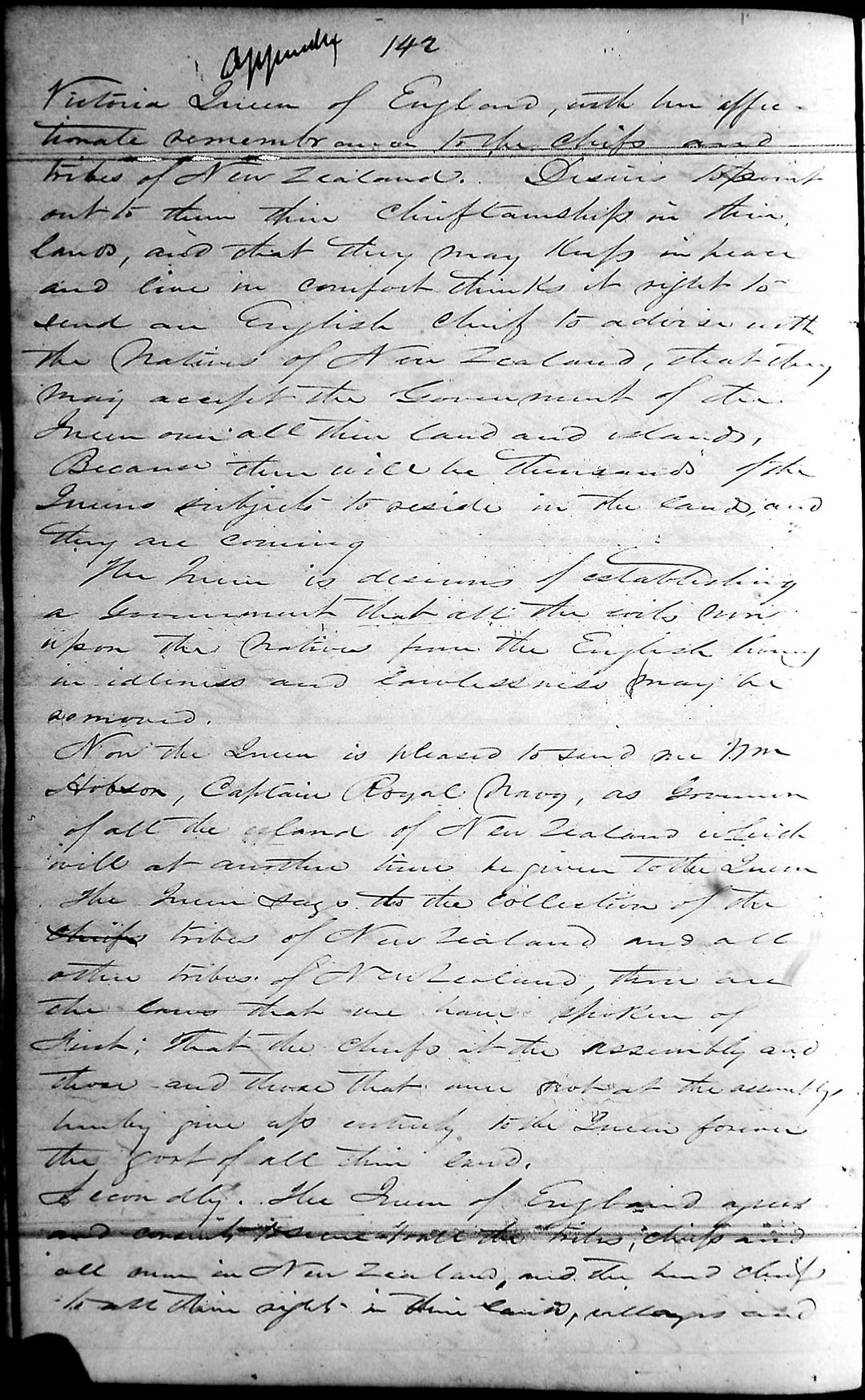
The first page shown (93) is a transcript of Captain Gordon Brown’s back-translation of the official Maori text. The original document by Brown survives amongst the Clendon House Papers, Special Collections, Auckland Public Library. It would appear that Wilkes asked for impartial verification that the printed Maori treaty back-translated to the official English text, as supplied by Clendon. The Gordon Brown text runs through page 142 of the U.S.S. Vincennes’ letter book to midway down page 143.
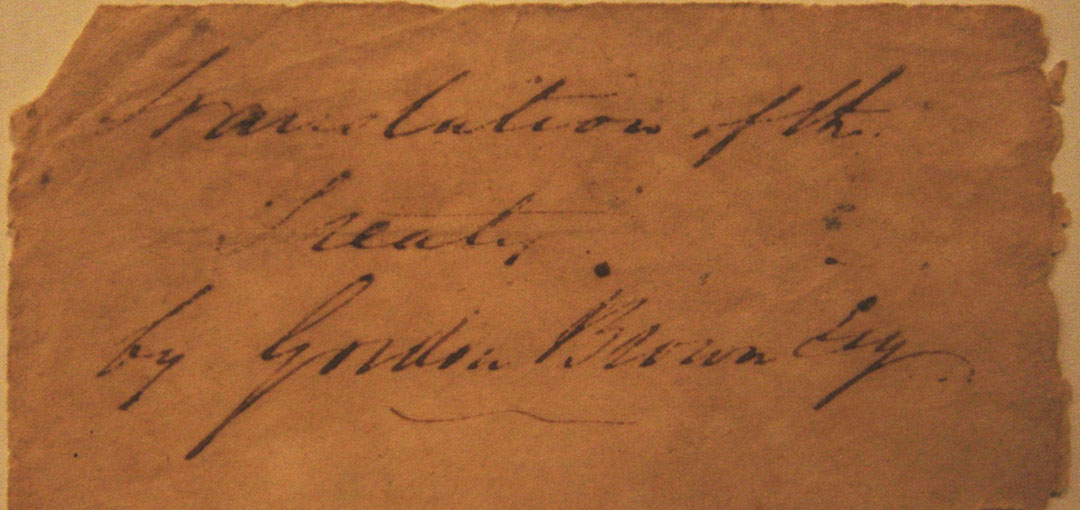
Amongst the Clendon House papers are two back-translations of Te Tiriti o Waitangi, one of which was done by Captain Gorden Brown. Commodore Charles Wilkes first copied Brown's English "Translation" from the Maori text for comparison to the Hobson-Busby Final Draft English text.
At this point the U.S.S. Vincennes’ letter book recommences with the official English text and calls it the ‘Translation’. It will be remembered that Clendon applied, officially, to the Hobson Government for ‘a copy and translation of the Treaty for the purpose of sending it to the Government of the United States.’ He, subsequently, was sent a handwritten copy of the Maori Tiriti O Waitangi, penned personally for him by Reverend Henry Williams. This document, supplied to satisfy Clendon’s official request, was signed by James Stuart Freeman as a “True Copy”.
But Clendon had also asked for the official English text,
which he called the ‘translation’. This was supplied along
with the official Maori ‘copy’ By giving Clendon the two requested
documents, Hobson had fulfilled his diplomatic obligations to the Consulate
of the United States of America.
A very careful reading of the official ‘translation’ supplied
by U.S. Consul, James Reddy Clendon to Commodore Charles Wilkes, shows that
Wilkes’ secretary transcribed Busby’s final draft (the Littlewood
Treaty). The U.S.S Vincennes’ secretary went so far as to deliberately
copy known writing errors of text and spelling, which are only found on
Busby’s final draft. In doing so, he demonstrated beyond any
doubt, that the English document supplied by Clendon was none other than
the document we now call “The Littlewood Treaty”.
Although we have not, as yet, been able to access a copy of Wilkes’ despatch No. 64 from the U.S. authorities in Washington D.C., the U.S.S. Vincennes’ letter book records precisely what was sent by Wilkes on the 5th of April 1840.
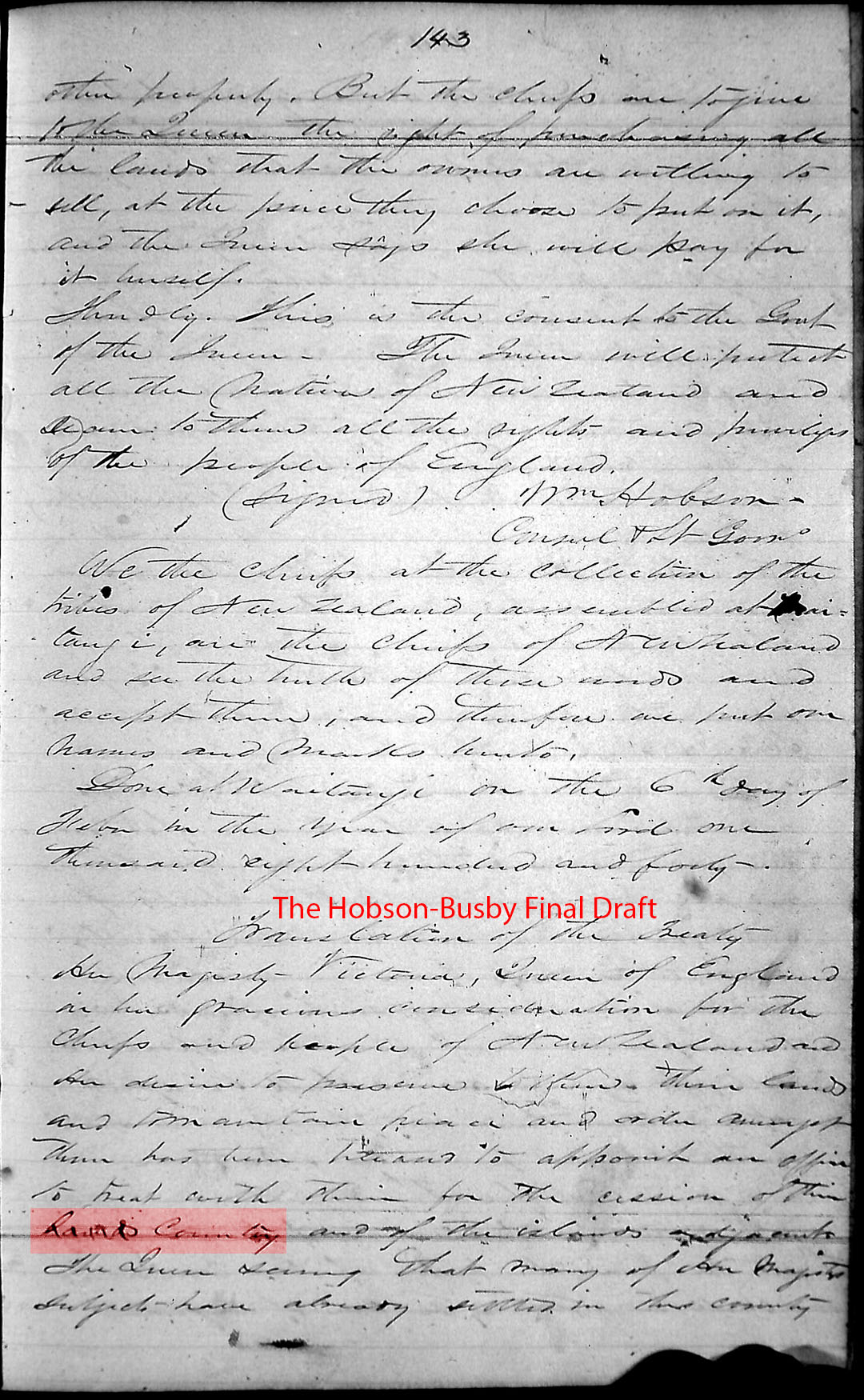
This first part of Wilkes'transcription commences with Captain Gordon Brown's back-translation of the Maori language Tiriti o Waitangi text:
|
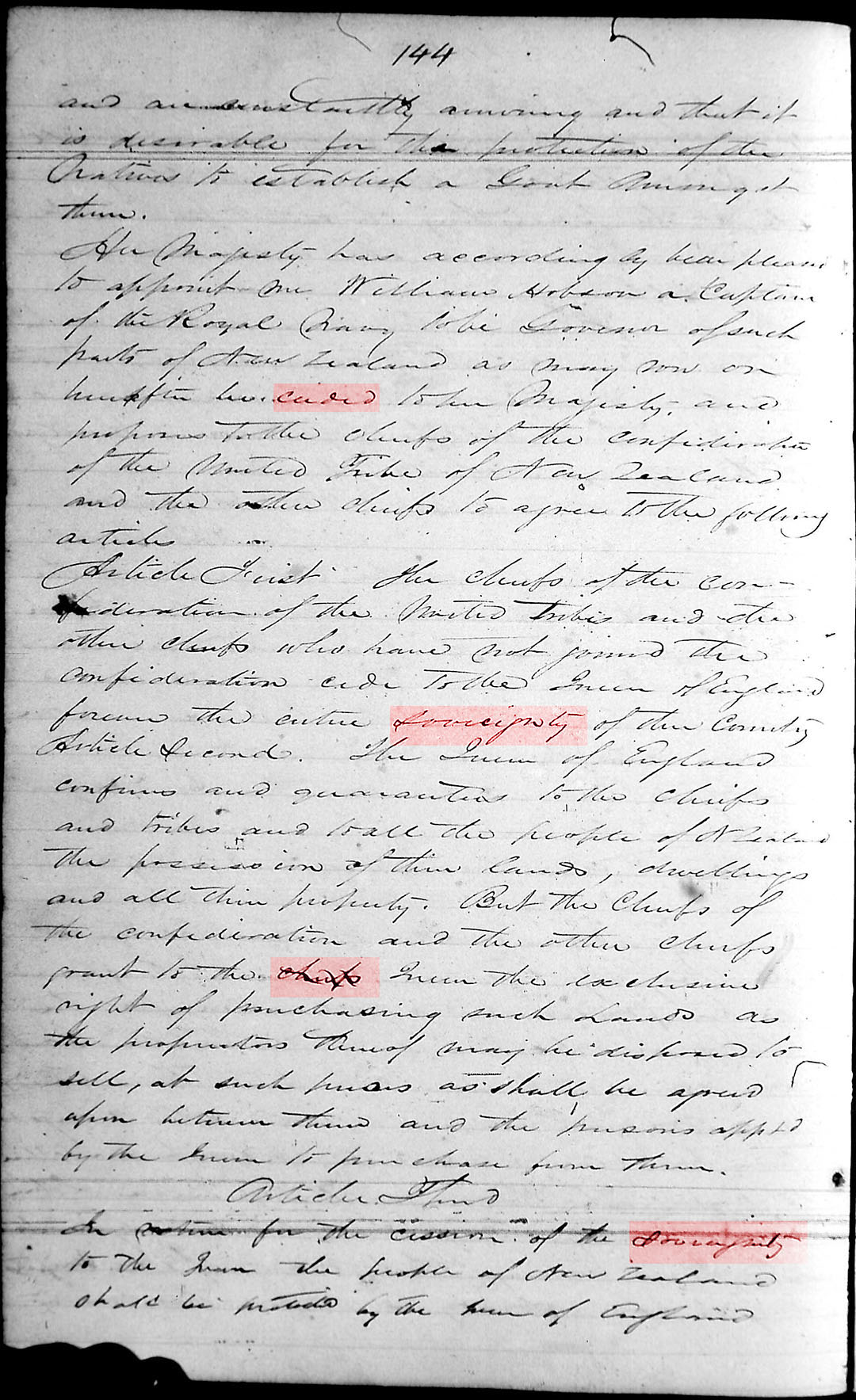
BUSBY’S FINAL DRAFT …4th of February 1840 (Littlewood Treaty). Her Majesty Victoria, Queen of England in Her gracious consideration for the chiefs and people of New Zealand, and her desire to preserve to them their land and to maintain peace and order amongst them, has been pleased to appoint an officer to treat with them for the cession of the Sovreignty of their country and of the islands adjacent to the Queen. Seeing that many of Her Majesty’s subjects have already settled in the country and are constantly arriving; And that it is desirable for their protection as well as the protection of the natives to establish a government amongst them. Her Majesty has accordingly been pleased to appoint me William Hobson a captain in the Royal Navy to be Governor of such parts of New Zealand as may now or hereafter be ceided to her Majesty and proposes to the chiefs of the Confederation of the United Tribes of New Zealand and the other chiefs to agree to the following articles.- Article first The chiefs of the Confederation of the United Tribes and the other chiefs who have not joined the confederation, cede to the Queen of England for ever the entire Sovreignty of their country. Article second The Queen of England confirms and guarantees to the
chiefs & tribes and to all the people of New Zealand the possession
of their lands, dwellings and all their property. But the chiefs of
the Confederation and the other chiefs grant to the Article Third In return for the cession of the Sovreignty to
the Queen, the people of New Zealand shall be protected by the Queen
of England and the rights and privileges of British subjects will
be granted to them.- Now we the chiefs of the Confederation of the United
tribes of New Zealand being assembled at Waitangi, and we the other
chiefs of New Zealand having understood the meaning of these articles,
accept of them and agree to them all. |
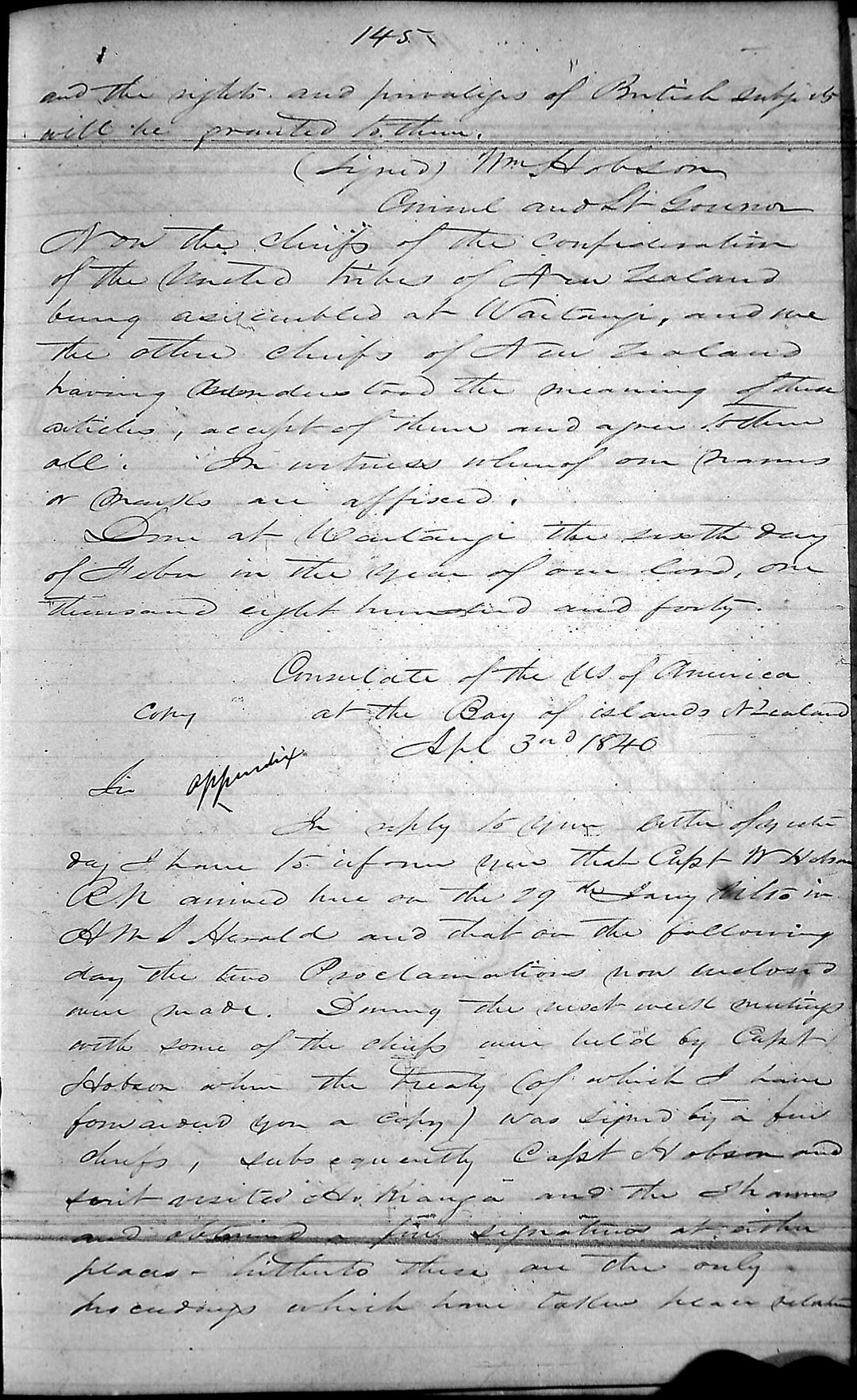
WILKES’ DESPATCH 64 TREATY ... 3rd of April
1840. Her Majesty has accordingly been pleased to appoint me William Hobson a Captain of the Royal Navy to be Governor of such parts of New Zealand as may now or hereafter be ceided to Her Majesty and proposes to the chiefs of the confederationof the United Tribes of New Zealand and the other chiefs to agree to the following articles Article First The chiefs of the confederation of the United Tribes and the other chiefs who have not joined the confederation cede to the Queen of England forever the entire Sovreignty of their country. Article Second The Queen of England confirms and guarantees to the
chiefs and tribes and to all the people of N Zealand the possession
of their lands, dwellings and all their property. But the chiefs of
the confederation and the other chiefs grant to the Article Third In return for the cession of the sovreignty to the Queen the people of New Zealand shall be protected by the Queen of England and the rights and privileges of British subjects will be granted to them. Signed Wm Hobson Now the chiefs of the confederation of the United Tribes of New Zealand being assembled at Waitangi and we the other chiefs of New Zealand having understood the meaning of these articles, accept of them and agree to them all. In witness whereof our names or marks are affixed. Done at Waitangi the sixth day of Febu in the year of our lord, one thousand eight hundred and forty. Consulate of the US of America at the Bay of Islands N Zealand.April 3rd 1840. |
It can be readily seen that Busby’s final draft wording of the 4th of February 1840 was made available to Commodore Charles Wilkes on the 3rd of April 1840. This was the same, physical document that was found in deceased estate papers by the Littlewood family in 1989.
The subsequently copied transcript shows that Wilkes or his secretary (copying the despatches, or letters sent and received within the squadron, into the U.S.S. Vincennes’ letter book) has been a bit inattentive or hurried and has left out “of the Sovereignty” in the Preamble, or has abbreviated some words. Other than this, the general text is the same as Busby’s 4th of February final English draft of the Treaty.
It is beyond dispute that the Wilkes’ transcript was copied directly from Busby’s final draft, as the copyist has religiously tried to duplicate all of Busby’s mistakes or corrections, as found upon the Littlewood Treaty.
Where the somewhat inattentive copyist left out the word “Sovereignty”
in the first instance, one can see he first put in “land”, but didn’t fully rectify or recover from the mistake. The transcribing
secretary has even copied Busby’s spelling mistake for “Sovreignty”
on two occasions, leaving out the telltale “e” quite
deliberately. The same holds true for the “crossed out” word
chiefs where Busby had earlier written the wrong word into
his final draft in Article II, then had to replace it with “Queen”.
Wilkes or his secretary duplicated Busby’s mistake by crossing out
chiefs and adding “Queen”. Even the mistake
Busby had made in writing “ceded” as “ceided”
was picked up by the copyist and recorded (See Papers of Charles
Wilkes 1837-1847, U.S.S. Vincennes letter book duplicate of despatch
Number 64, Microfilm 1262, University of Auckland Library pp. 142-145
& 163-168). The original Wilkes’ Papers are held at, The Kansas
Historical Society, Topeka, Kansas, U.S.A., and the microfilm reproduction
of them was made in 1953.
The 4th known final draft treaty text, sent by Wilkes as despatch 64 to Washington D.C., (which the U.S.S Vincennes’ letter book records as having been sent on April 5th 1840) should still survive in the U.S National Archives.
On April 3rd 1840 Clendon gave a general account of recent political events in New Zealand in order to bring Commodore Wilkes fully up to date. This was in response to Wilkes’ direct enquiry ‘into the actual state of these islands and what acts had taken place and how for the authority of the British Govt. had gone, and for the information of the Govt.’ Clendon wrote:
‘In reply to your letter of yesterday I have to inform you that
Capt. W Hobson, R.N. arrived here on the 29th Jany. [last?] in H.M.S.
Herald and that on the following day the two Proclamations now enclosed
were made. During the next week meetings with some of the chiefs were
held by Capt. Hobson where the Treaty (of which I have forwarded you a
copy) was signed by a few chiefs, subsequently Capt. Hobson and suit visited
Hokianga and the Thames and obtained a few signatures at other places
- hitherto these are the only proceedings which have taken place relative
to any cession of rights by the chiefs of New Zealand to the British Crown.
Referring to the above the other apparent reasons taken by Capt. Hobson
to establish the British authority here are the holding a court of session
at Kororarika which is in active operation, having a strong police force
under its control. The formation of a General Post for N. Zealand and
the appointment of various Govt. officers for New Zealand by his Excellency
the Governor of New South Wales.
It is however to be remarked that no laws relative to the mode or form
of Govt. intended to be pursued in the colony have as yet been published
-
I have the honor to be & c
James R. Clendon
U.S. Consul
U.S. Ship Vincennes
Bay of Islands N. Zealand
April 3rd 1840.
In the final analysis, we see a plausible chronology of events unravelling, with respondent, Clendon acting very responsibly and attempting to provide his superiors in Washington D.C., or Commodore Charles Wilkes, with accurate information. When Clendon was slightly unsure of the official status of his despatch number 6, English treaty transcript (20th of February 1840), he said he would apply officially for a "copy and translation" of the treaty directly from Hobson. This he did and Acting Colonial Secretary, Willoughby Shortland, fulfilled his request. Before the 18th of March 1840 Clendon came into possession of the final draft document that Hobson, plausibly, carried on his person or in his travels and was able to make this available to Commodore Charles Wilkes about two weeks thereafter.
So, how did 1840s-50s solicitor, Henry Littlewood end up with Busby’s final English draft of the treaty?
The final English draft original document, once supplied, remained with Clendon, thereafter, and was never returned to the government.
In later years (1856), at least, and conceivably much earlier, Henry Littlewood was James Reddy Clendon’s solicitor and was employed to do conveyancing work for Clendon. Some receipts still exist amongst the Clendon House Papers, showing payment being made by Clendon to Littlewood for completion of legal work. These can be viewed at Special Collections, Auckland Public Library.
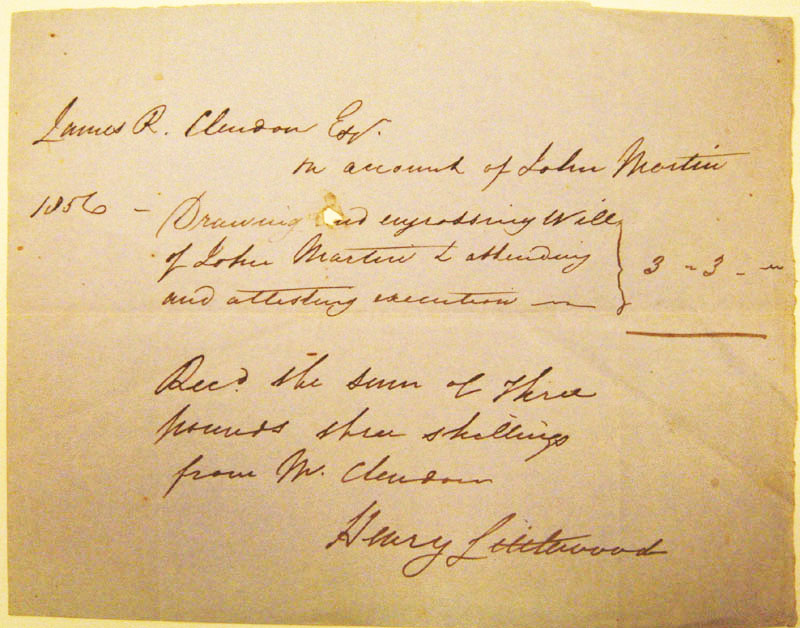
A receipt issued by Henry Littlewood to James Reddy Clendon, dating to 1856, for work in account of the will of John Martin. Littlewood charged Clendon £3. 3/-. 0d. for legal services. The pedigree of the final treaty draft from Busby-to-Hobson-to-Clendon-to-Littlewood is, therefore, clear and impeccable.
Another, more unlikely possibility that should be considered relates to the fact that that Henry Littlewood was a practising solicitor in Auckland around the time Hobson died there on September 10th 1842. Did Eliza Hobson lodge important, original historical documents, related to New Zealand’s Treaty of Waitangi, with Littlewood’s firm prior to her departure to England?
Another opportunity for the acquisition of some salvaged documents might have arisen when Hobson’s Auckland mansion, the seat of Government, burnt down in 1848. Henry Littlewood was a practising solicitor in Auckland during 1841 & also 1848-49. Littlewood might have taken legal trust custody of some official documents. Also, in 1841 & 1842 Governor Hobson initiated a period of intensive lawmaking, with the creation of his new Legislative Council and was using the expertise of Auckland’s judges, lawyers and solicitors.